
Your Birth Chart Is Your Psychological Blueprint — How and Why It Works
 AstroWakeUp
Your Birth Chart Is Your Psychological Blueprint — How and Why It Works
Birth Chart should taken as a map of the mind, not only a tool of prediction of fate
Most people approach astrologers expecting predictions: When will I succeed? When will I marry? Will this year be good or bad? But Vedic astrology, at its deepest level, is not primarily about prediction. It is equally about your psychology. Long before it tells you what will happen, it explains who you are internally, how your mind works, and why you repeatedly respond to life in the same patterns.
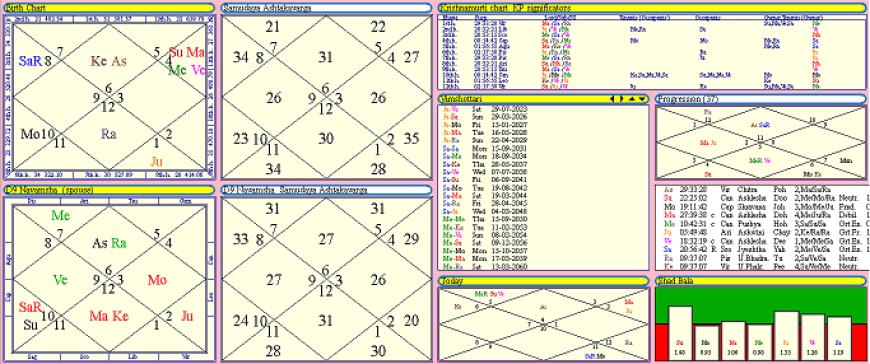
This is why a Vedic birth chart is best understood as a psychological blueprint. It does not describe random traits. It maps the structure of the mind, the conditioning of emotions, the style of thinking, the coping mechanisms under stress, and the way identity is constructed over time. Events happen later. Psychology comes first.
Why the Birth Chart Is Psychological, Not Just Predictive
In Jyotish, the moment of birth is not treated as accidental. It is seen as the moment when consciousness enters a physical body with a pre-existing karmic and psychological structure. The planetary positions at that moment capture the state of mind the soul brings into this life. This is why two people raised in the same family, under the same circumstances, can turn out psychologically opposite. Their charts are different, so their internal wiring is different.
Vedic astrology assumes a simple but profound truth:
Life does not shape the mind alone. The mind also shapes how life is experienced.
Your chart therefore answers questions like:
Why do you overthink even when things are fine?
Why do you crave control, reassurance, distance, or validation?
Why do certain situations trigger fear while others energize you?
Why do you repeat the same emotional mistakes even after learning the lesson intellectually?
These patterns are not moral flaws. They are psychological signatures, and they are clearly visible in the birth chart.
The Ascendant: The Structure of Identity
The Ascendant (Lagna) is the foundation of psychological identity. It shows how a person experiences the world and how the ego organizes reality. A fiery Ascendant experiences life as a challenge to conquer. An earthy Ascendant experiences life as something to stabilize and manage. An airy Ascendant processes life through ideas and comparisons. A watery Ascendant processes life emotionally and intuitively.
But more importantly, the Ascendant lord shows how the ego protects itself. Where that planet sits, the mind repeatedly goes for safety and validation. This is why some people seek security through work, others through relationships, others through control, and others through withdrawal. These are not choices made consciously. They are ego-defense strategies embedded at birth.
The Moon: The Emotional Operating System
If the Ascendant is the structure of identity, the Moon is the emotional operating system. It shows how the mind reacts automatically, without logic. The Moon governs fear, comfort, attachment, memory, and emotional habits. When the Moon is stable, the person can endure external stress. When the Moon is unstable, even success feels unsafe.
The Moon sign gives the emotional climate, but the Moon Nakshatra gives the emotional reflex. This is why Vedic astrology is exceptionally precise in psychological analysis. It does not generalize emotions. It specifies them.
Some Moon Nakshatras crave closeness, some crave usefulness, some crave control, some crave freedom, and some crave transcendence. When these needs are unmet, emotional imbalance appears. When they are met, the person feels internally aligned—even if life is difficult.
Mercury, Venus, Mars, Saturn: The Mental Tools
Mercury shows how a person thinks, analyzes, learns, and communicates. Venus shows emotional value systems, attachment style, pleasure-seeking, and relationship psychology. Mars shows aggression, assertion, anger patterns, and how conflict is handled. Saturn shows fear, discipline, guilt, endurance, and long-term psychological pressure.
Together, these planets do not describe behavior alone. They describe inner experience. Two people may act similarly but feel completely different internally. Vedic astrology focuses on the feeling, not just the action.
Real-Life Example 1: Albert Einstein
A chart built for abstract thinking, isolation, and inner intensity
Birth Details (commonly used in astrology):
-
Date: 14 March 1879
-
Time: 11:30 AM
-
Place: Ulm, Germany
Albert Einstein’s chart is one of the clearest demonstrations that astrology describes mental structure, not superstition. His chart shows extraordinary emphasis on abstract thinking, internal visualization, and detachment from conventional reality.
Einstein had a strong Aquarius–Pisces influence, emphasizing imagination, intuition, and non-linear thinking. Psychologically, such charts struggle with routine, authority, and rigid systems, but excel in conceptual breakthroughs. Einstein famously struggled in traditional classroom environments, not because of lack of intelligence, but because his mind did not operate linearly. His chart shows a mind that visualizes first and rationalizes later.
His Moon and Mercury placements indicate a person who lived more comfortably in the inner world than in social structures. This explains his emotional distance in personal relationships, his preference for solitude, and his intense internal focus. His genius was not accidental. It was psychologically encoded.
The same chart also shows difficulty in emotional intimacy. Einstein’s personal life was complex and often strained. This was not a moral failure; it was a psychological imbalance between intellectual absorption and emotional presence. Astrology does not judge this. It explains it.
Real-Life Example 2: Princess Diana
A chart of emotional openness, empathy, and vulnerability
Birth Details:
-
Date: 1 July 1961
-
Time: 7:45 PM
-
Place: Sandringham, England
Princess Diana’s chart is often cited to demonstrate how external privilege does not guarantee internal security. Her Moon, the core of emotional psychology, is deeply sensitive and relationship-oriented. Her chart shows a strong need for emotional reciprocity, affection, and personal bonding.
Psychologically, such a chart cannot survive emotional coldness. Diana’s suffering did not arise from lack of comfort, wealth, or status. It arose from emotional neglect and relational isolation. Her eating disorders, anxiety, and emotional distress are classic manifestations of a Moon that feels unseen and unloved.
At the same time, this same emotional openness made her extraordinarily empathetic. She connected instinctively with suffering people, children, the sick, and the marginalized. Her chart shows emotional permeability—the ability to feel others deeply. This is not weakness. It is psychological sensitivity.
Her tragedy was not written in events alone. It was written in emotional mismatch—a sensitive inner world placed inside a rigid institutional structure. Astrology explains this mismatch long before the outcome.
Why Repetition Is the Proof of the Blueprint
One of the strongest proofs that the birth chart is psychological lies in repetition. People repeat emotional patterns even when circumstances change. They change partners but repeat the same relationship pain. They change jobs but feel the same dissatisfaction. They achieve success but feel the same insecurity.
This happens because the external environment changes faster than the internal wiring.
The birth chart shows this wiring. Until awareness develops, the same planetary patterns express again and again through different people and situations. This is why Vedic astrology places such importance on self-knowledge. Awareness does not erase the blueprint, but it allows conscious navigation.
Dashas: When Psychology Comes to the Surface
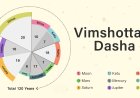
Planetary periods (Dashas) do not create new psychology. They activate existing psychological components. A Saturn Dasha intensifies fear, responsibility, and self-doubt already present in the chart. A Venus Dasha amplifies attachment needs, relationship focus, and emotional desire. A Moon Dasha brings emotional issues to the forefront, often through family, relationships, or mental health.
This is why people say, “I don’t recognize myself anymore” during certain phases of life. They are not changing. A different psychological layer is being activated.
Astrology vs Modern Psychology
Modern psychology studies behavior through observation and therapy. Vedic astrology studies psychology through time and structure. Psychology asks, “Why do you feel this way?” Astrology asks, “Why do you always feel this way, and when will it intensify or resolve?”
These two systems are not enemies. They are complementary. Astrology explains pattern and timing. Psychology helps with processing and healing.
Conclusion: The Chart Does Not Limit You — It Explains You
Your birth chart is not a prison. It is a map. It does not say what you must become. It explains why becoming certain things feels easier or harder for you. It explains your emotional blind spots, mental strengths, fears, desires, and coping strategies.
When Vedic astrology is used deeply, it does not predict doom or promise miracles. It offers something far more valuable: clarity about the self.
And when you understand your psychological blueprint, life stops feeling confusing.
You may not control time—but you finally understand your mind moving through it.